
What the pheasant season means
A pheasant season is a defined legal period that applies to the taking of pheasants, rather than a general measure of when every game bird is available. Its meaning depends on the species and the UK nation concerned, because the rules are not uniform across the country. The term identifies when a legal open period applies, but it does not describe the supply of meat in shops or from game suppliers. Those are separate questions, with different information needed to answer each one.
Season dates and legal periods
A pheasant season is a legally specified period during which the relevant rules permit the taking of that species, subject to the applicable law. It is a calendar window, not a recommendation to shoot and not a guarantee that pheasants will be present on a particular site. Outside the open period, the season itself does not provide a basis for taking pheasants.
The relevant dates and rules can differ between England, Wales, Scotland and Northern Ireland. They can also differ between pheasants and other game species, so a date that applies to one bird or nation should not be assumed to apply elsewhere. In practice, season information needs to identify both the species and the jurisdiction before it can be interpreted correctly.
For example, a reference to the pheasant shooting season in England concerns pheasants under the rules applicable in England; it is not a UK-wide date for all game birds. The open season for pheasants is a species-specific legal period tied to the relevant nation.
Legal season and meat availability
Legal season information and meat availability answer different questions: one concerns a permitted period, while the other concerns current supply.
| Comparison | Legal season information | Meat availability |
|---|---|---|
| Meaning | A calendar period for 1 named species in 1 UK nation, such as pheasant in Scotland. | Whether a supplier has pheasant meat in stock now, in a stated format such as a whole bird or portions. |
| What it establishes | Whether a stated date falls within the applicable open period for that species and nation. | Whether a product can currently be bought from that particular supplier. |
| What else is needed | The species, UK nation and date: 3 details needed to interpret the period. | A current stock check, product format and sourcing information; availability can change with supply and distribution. |
A season date does not confirm current availability. A pheasant may be in season while a particular seller has no stock, and meat may be offered through supply arrangements that do not mirror the legal calendar exactly. Check the seller’s current listing or ask about the specific product and its source rather than treating a season date as evidence that it is available to buy.
How dates vary across the UK
The UK has four legal jurisdictions, and game-shooting provisions are not necessarily identical across them. A date in a national guide must be checked against the law for the place where the shoot takes place. Amendments, species schedules and qualifying conditions can affect how a provision applies. Identify the relevant nation and verify the current official rule before relying on a date.
Identify the relevant UK nation
Before interpreting a pheasant season date, establish where the shooting would take place: England, Wales, Scotland or Northern Ireland. The UK does not have one single wildlife-law code governing every detail in all four nations. Devolution means the relevant legislation and regulatory instruments may differ, so a date quoted for the pheasant shooting season in England cannot automatically be applied to a shoot in Wales, Scotland or Northern Ireland.
Some core statutes cover Great Britain, while Northern Ireland has a separate legislative framework; for example, the Wildlife and Countryside Act 1981 applies in Great Britain, and the Wildlife (Northern Ireland) Order 1985 is a central instrument in Northern Ireland. Amendments and detailed provisions still matter. Identify the nation where the land lies, rather than relying on the shoot organiser’s location, a retailer’s address or a guide written for another jurisdiction. For land near a national boundary, check the precise location of the proposed activity and use the rules for that side.
Checks before relying on a date
Use a nation-by-nation check rather than carrying a date across the UK; then confirm that the provision covers the bird and activity in question.
- Confirm the place of the proposed shoot, including the nation in which the land lies; a nearby border does not make another nation’s rules applicable.
- Check that the rule concerns pheasants specifically, not another game bird; close seasons and legal treatment can differ between species.
- Consult current official legislation and amendments for that nation, rather than relying on an old calendar, archived guidance or an undated shooting reference.
- Read the provision’s exact opening and closing period, including how it treats the first and last day; do not infer dates from another nation.
- Check any stated qualifications or conditions, such as an exception, a restriction on a particular place, or a requirement tied to the activity.
- Look for additional site-specific restrictions that may apply to the land; a general season rule may not settle every condition at a particular location.
- Confirm separately whether landowner permission, a relevant licence or other authorisation is needed; a season date alone does not establish permission to shoot.
Verify the rule in force with the relevant nation’s official legislation or wildlife authority immediately before relying on a date.
Pheasant and other game seasons
A mixed day’s shooting may involve more than one quarry species, but the season named in a notice may be narrower than the phrase used for the day. Pheasant-season information concerns pheasants alone. “Game season” can cover several kinds of quarry, including birds and mammals. Their legal periods are not automatically aligned.
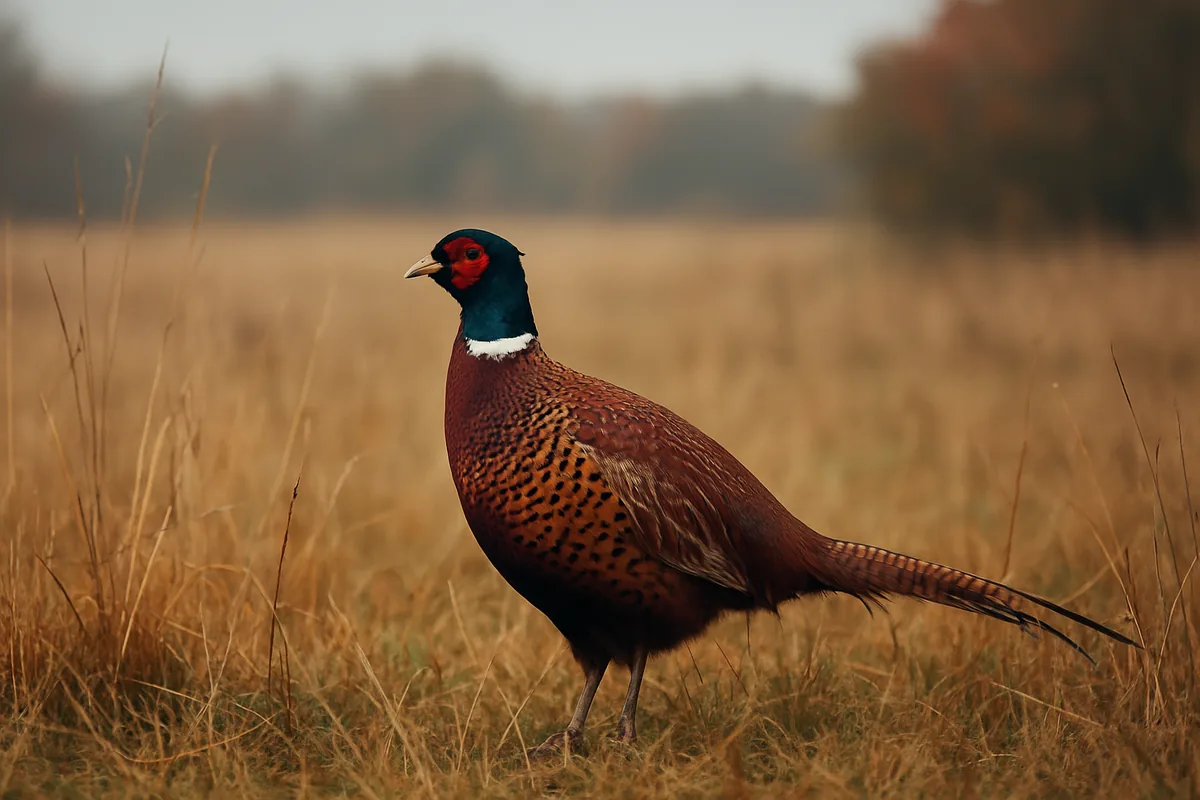
Pheasant season and game season
Pheasant-season information is species-specific: it concerns the legal period for taking pheasants, not every quarry species that may be pursued in the same countryside or on the same shoot. The phrase “game season” is broader and can refer collectively to seasonal opportunities for several kinds of game, each governed on its own terms.
This distinction matters when a shoot includes more than pheasants. A programme may list pheasant and partridge days together, but a shared venue or date does not make the species’ open periods interchangeable. A pheasant shooting season notice answers a narrow question about pheasants; it cannot, by itself, establish whether grouse or hare may also be taken that day. Likewise, “game season” is an umbrella phrase, not a single legal framework that synchronises every quarry calendar. Read a species name as the scope of the information, and treat broader references as covering multiple rules rather than one common start and finish.
Different species, different rules
Four familiar examples show why a game season cannot be treated as one shared calendar. Pheasant, partridge and grouse are gamebirds, while hare is a mammal.
- Pheasant: A notice about pheasant shooting applies to pheasants; its season does not automatically set the lawful period for partridge, grouse or hare.
- Partridge: Red-legged and grey partridges are separate gamebirds; identify the relevant species rather than transferring a pheasant period to either.
- Grouse: Red grouse shooting follows its own seasonal framework, and local management or access arrangements do not replace applicable wildlife law.
- Hare: Hares are mammals, unlike the three birds above, and their inclusion in broader game terminology does not make bird-season rules applicable.
For each species, the relevant law may set a different open period or other conditions; a season attached to one does not establish the status of another. A mixed-game programme can therefore refer to several species whose rules remain distinct.
Seasonality and cooking
Seasonal context can help explain why pheasant appears in discussions of game meat at particular times of year. It describes the calendar around the bird, not the stock held by a shop or supplier. For cooking, the bird’s species, cut and size matter more than the season in which it was taken. Match cooking instructions to the actual preparation rather than relying on a general game-bird method.
What season information can tell you
Season information places pheasant within the UK’s annual game calendar and gives context to references to seasonal eating. It can explain why the bird is associated with a particular part of the year, or why recipes and menus may discuss pheasant as a seasonal ingredient. That context is useful when reading about game meat, but it is not a stock report: a season date does not establish whether a particular bird is currently available from a retailer, butcher or game supplier.
Availability depends on the individual bird and the route by which it is supplied. A bird offered for sale may have been frozen, stored or brought to market at a different time from when it was shot; the season alone does not reveal those details. Check the seller’s information for the bird’s condition and preparation, especially whether it is fresh or frozen and whether it is whole or portioned. Treat seasonality as background to the food, then use product-specific information to decide how to cook it.
Use bird-specific cooking guidance
Pheasant is lean game, and instructions for another bird or cut may not suit it. Before choosing a method, check the guidance against the exact preparation in front of you:
- Species: Confirm that the instructions are for pheasant, rather than partridge, grouse or chicken, which differ in size and meat characteristics.
- Whole bird or cut: A whole oven-roasted pheasant cooks differently from separate breasts, legs or a boned joint; use guidance for the matching form.
- Size and weight: Check the bird’s stated weight or the cut’s thickness, since cooking time depends on how much meat is being heated.
- Preparation: Note whether the bird is bone-in, boneless, stuffed or prepared in another way, as each changes the cooking setup.
- Cooking method: Choose instructions specifically for roasting, pot-roasting, braising or pan-cooking; these methods use different heat and cooking times.
Use the recipe’s stated doneness checks and adjust only where its guidance allows for a different weight or cut. For a whole pheasant, a whole-bird method is the closest match; for breasts or legs, follow cut-specific directions instead.